
Earlier this month, I had the opportunity to listen to several sessions of a “Nervous System Reboot” summit. The speakers included a lot of big names Peter Levine, Pat Ogden, Bessel van der Kolk, and Dan Siegel—pioneers in their respective fields with many decades of research and psychotherapeutic practice. Having had c-PTSD since before I was a teenager, I’m personally interested in these things, but they’re also helpful in our ministry, because I often interact with abuse victims (i.e., people who have fled to Okinawa from abusive husbands, among others).
What Trauma Does
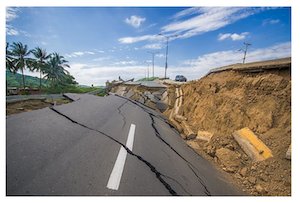
One key aspect of trauma is that it seems to knock you off balance. The ground feels unstable, as if your world is constantly experiencing tectonic shifts, and you feel as though you’re staggering and trying to regain your sense of equilibrium.
The sense of threat is potent, and the fight/flight/freeze response is activated. People who are in situations where it’s impossible to fight or flee will freeze. [1] In the case of PTSD, this may lead to a dissociative response—in which the brain largely turns off. To illustrate, look at the following two fMRI scans:
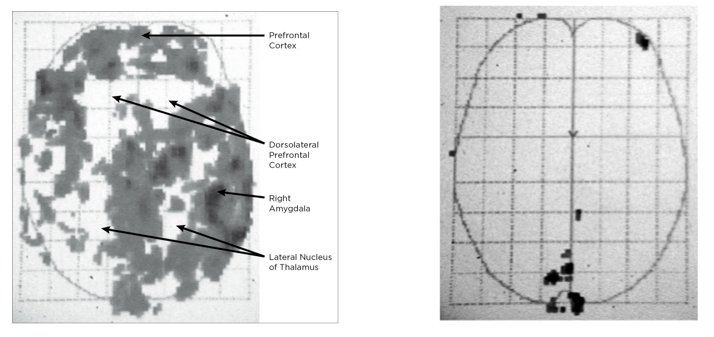
LEFT: the brain of someone having a flashback
RIGHT: the brain of someone in a dissociative state—largely off [2]
In dissociation, a person feels disconnected from their body, perhaps observing it from a ‘safe’ distance (i.e., across a perceptual chasm). This response may become activated not only in the midst of the original trauma, but later on when a person is exposed to a situation that’s similar in some way to the earlier traumatic one. Over time, with the proper psychotherapeutic interventions, trauma responses can be addressed and resolved.
Grounding: A Vital Concept
When attempting to heal from trauma, the concept of “grounding” is an important one. Essentially, grounding means that a traumatized person leverages certain mechanisms of the body’s nervous system to achieve a new sense of connection with their body and the world around them—not observing from a distance, but plugged in once again to physical sensations, and able to interact with the world with a greater sense of immediacy. There is no longer a mental barrier between themselves and the perceived dangers in the world. The tectonic shifts die down, and equilibrium is restored.

In a session named ‘Rebuilding the Sense of Self After Trauma’, led by Dr. Ruth Lanius, a neuroscientist and professor of psychiatry specializing in PTSD, I heard about a massive international study involving some of the most dissociative people around the world. The results were startling. Researchers found that unless they helped traumatized, dissociative people become grounded first, other therapeutic interventions weren’t successful. [3] This makes sense. How can dissociating people internalize deep psychological therapies if their nervous systems are still in “threat response” mode?
Spiritual Implications
Listening to the research findings, I couldn’t help thinking, “This surely has implications for our spiritual selves as well.”
- Unless they’re grounded, can traumatized people interact with God with the same immediacy as the untraumatized?
- If someone is trapped in a dissociative state, brain off, can they truly experience the fulness of God and His spiritual healing?
At the time of the summit, I was in the midst of dealing with a situation related to a former abuser, and battling my own dissociative response, so I thought I would try an experiment.
I lengthened my devotional times, and began with 15-30 minutes of grounding exercises before engaging in my usual devotional practices. This led to an increased ability to experience a sense of connection to God, and to hear His voice without the static of trauma. No longer was I disconnected from my body. My sense of touch, sight, and smell were all more vibrant.
So, in my experience at least, incorporating grounding practices can make a massive difference in the way we experience devotions, and spiritual healing in the hands of God. (If you’re new to grounding practices, I’ll put a few resources at the bottom of this post for you.)
Grounding in Community
Before leaving this topic, I would like to mention one other thing. In her session, Dr. Lanius also mentioned that our most basic sensory system is balance. When we’re traumatized, we lose gravitational security, and can’t feel grounded. However, we can take steps to activate our bodies’ balance systems. Engaging in rhythmic exercises, such as dancing, singing, drumming, or clapping can help. Doing these things in groups can increase our sense of attunement; the mirroring of actions between different people can be profoundly calming and stabilizing. [3] That’s because regulated nervous systems can help regulate dysregulated ones.
Now, think about your typical worship service at church. There’s singing. Possibly swaying to the music—which happens a lot in Okinawan churches. Clapping. And so on. Then, after all of this grounding and nervous system regulation, we listen to a sermon. Only after we’re all attuned to one another and to the Holy Spirit do we attempt to absorb teaching.
How fascinating to understand these practices through the lens of our nervous systems. This pattern exists for a reason—even if we haven’t fully understood it before.
Perhaps you, too, will find it helpful to pull some of these principles into your own devotional times. May they help you to connect more deeply and reliably with your Heavenly Father, even in the midst of nervous system turmoil and the dysregulation associated with trauma. Enjoy His peace, precious sister and brother.
RESOURCES
- Healing Trauma, by Peter Levine
For those who have been severely traumatized, this is a particularly good resource. Although I usually prefer paper books, personally, I like the e-book version from Apple better, because it includes audio tracks of his various exercises. So, you can be guided through each exercise without having to read something.
- The Body Keeps the Score, by Bessel van der Kolk
This is a good resource to give you an idea of the variety of therapeutic treatments for trauma available today. I have engaged in several of them.
- Grounding Techniques
Here are a few sites with some good ideas: Cleveland Clinic, and Healthline
Please note that not all grounding techniques work for everyone. Each nervous system is different. The things that work for me may not work for you. However, if you’d like to know the ones I find most helpful, they are: the 5-4-3-2-1 technique, applying ice to the vagal nerve between my eyebrows, petting cats, breathing in quickly and then out for as long as possible, Pilates full body stretches, the exercises in Peter Levine’s book (above), and connecting with nature.
NOTES
[1] David Grand. 2026. ‘The Eyes as a Gateway to Healing: Brainspotting and Nervous System Repair’, Nervous System Reboot Summit 2026 <https://www.nervoussystemrebootsummit.com> [accessed 8 June 2026]
[2] Both scans taken from Bessel van der Kolk. 2014. The Body Keeps the Score: Brain, Mind, and Body in the Healing of Trauma (Penguin): Chapter 4. Running for Your Life: The Anatomy of Survival
[3] Ruth Lanius. 2026. ’Rebuilding the Sense of Self After Trauma: Default Mode Network, Memory, and Healing’, Nervous System Reboot Summit 2026 <https://www.nervoussystemrebootsummit.com> [accessed 29 May 2026]
Picture sources: