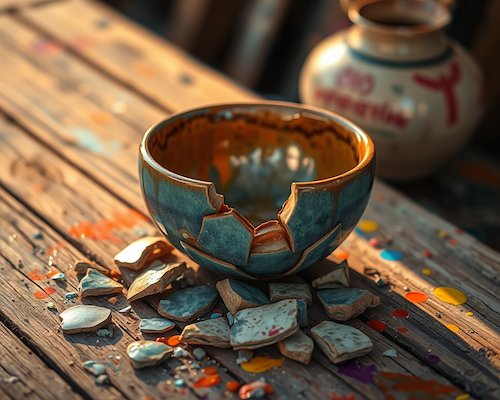
Let’s start by defining what “brokenness“ is, for the sake of this conversation. It is not autism. It is not physical disability. It is not some neurological or physical atypicality.
Brokenness can be the result of abuse, trauma, or decay. Whereas someone with a disability or condition may achieve a level of health within the parameters of that condition, brokenness is not healthy. It is not content to consume just one area of our lives, but wants to take over completely. It will demolish all sense of well-being. It will consume all hope, all health.
So let us return to the original question:
Is brokenness beautiful?
No, it’s not.
Brokenness is ugly. Ill. Gangrenous. Dysfunctional. Heartbreaking. A source of grief.
Brokenness is the result of sin.
It is not beautiful.
I’ve noticed a trend in recent years to celebrate brokenness. To hold it up. To showcase it. To demand not only acceptance, but celebration.
In recent days, I have been listening to the talks and lectures from a mental health summit. Most of them are useful and excellent, but there was one yesterday that made me feel a little ill.
Though she made many good points in her talk, at the end, the speaker talked about the need for us to celebrate brokenness. She used the example of Japanese kintsugi to illustrate her point.
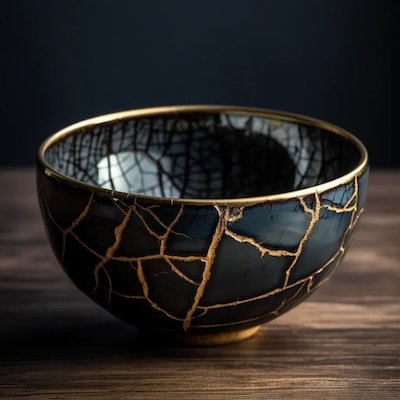
Kintsugi: A Japanese art form that puts broken pottery back together, filling the seams with gold.
“The Japanese,” she said, “celebrate their broken pieces, and so should we.” [1]
Keep in mind, this was said in the context of broken mental health.
Celebrating broken mental health is as ludicrous as celebrating the fact that someone has cancer.
We do celebrate people who have cancer, but we don’t celebrate the disease itself. We celebrate the courage of the person fighting the disease. We celebrate when that person has been able to conquer and enter remission from that disease. We celebrate the lives of those who succumb to it.
But the disease?
We hate it.
Likewise, the Japanese do not celebrate brokenness when they engage in kintsugi artwork. They celebrate the wholeness that can come out of brokenness, the beauty that the scars of fighting brokenness can create. If they celebrated the brokenness itself, they would never have put the pieces back together.
As someone once penned, “If there is love, scars are as pretty as dimples.” [2]
In order for a scar to exist, healing has to have taken place. Before that, we simply have an open wound.
In our Christian life, this is important to keep in mind. Of course, we accept and embrace people who struggle. We don’t reject them because they are broken. We allow their brokenness to draw from us compassion, mercy, care, love. We do what we can to humbly learn from their experiences. We allow ourselves to become “channels of blessing” who are the embodiment of Jesus’ own traits of compassion and gentleness.
But we cannot allow ourselves to celebrate that brokenness. [see 3 for further discussion] We cannot allow ourselves to be content with staying in places of brokenness.
That is not the future, nor the destiny, that Jesus has called us to.
Keep in mind, the Bible tells us, Jesus proclaimed that He was sent to “heal the brokenhearted”[4] and “set the oppressed free” [5] (the King James Version says, “set at liberty them that are bruised”).
So let us be agents of healing. Let us follow in our Saviour’s footsteps.
Let us rejoice in the process and result of healing.
Let us rejoice over the scars that are a testament to Jesus’ healing work in our lives, just as we rejoice in the scars on His hands, feet, and side, which are symbolic of the freedom He won for us at so great a cost.
NOTES
[1] This is a paraphrase, grouping a couple of statements at the end of her talk. Please note that she was talking about celebrating our brokenness in hope that it will be one day healed, but there’s still something off about celebrating brokenness. Her wording may simply have been imprecise, but this plays into the societal norms of embracing brokenness without healing. This is what deserves to be challenged. We can celebrate the healing process, but celebrating the brokenness itself is dangerous and unhealthy.
Dr. Josephine M. Kim, “Taking Pause for Mental Health in (Asian American) Churches,” October 10, 2023, Church Mental Health Summit 2023, all-access pass video, 21:10-21:42, 22:02-22:28.
[2] Attributed to a Japanese proverb by Stephen King, Fairy Tale (New York, NY: Scribner, 2022)
[3] I wonder if sometimes we get mixed up between brokenness (a continued state) and being broken-hearted over our sin (which is made up of discrete events, followed by changes in heart). Repentance from sin is a key ingredient in our spiritual healing. Where sin leaves us in a state of spiritual brokenness, when we realize our condition and how we grieve God, and come to Him in broken-hearted repentance, God forgives and heals us. He gives us the Holy Spirit who, the Bible tells us, gives us life (see 2 Cor. 3:6). The Holy Spirit does this by indwelling us (see 2 Cor. 6:16, 1 Cor. 3:16) and enables us to live lives that are holy and pleasing to God (see Gal. 5:16-25).
Being imprecise in our wording (for instance, equating “repentance” with “brokenness”) can have dire consequences for the Body of Christ. Singing, “Brokenness is what I long for, brokenness is what I need” is not biblically accurate, and can be quite dangerous to the mental health of the Body of Christ.
If we are broken-hearted at our sin, but refuse to repent, I suppose this would lead to a constant state of brokenness, but I hope that we can agree that perpetual broken-heartedness without repentance is not a spiritually healthy mindset.
[4] Luke 4:18, KJV.
[5] Ibid, NIV.