The story of Jonah has always puzzled me. I've returned to it several times in my writings, trying to make sense of it. So when I noticed Jonah in the list of possible topics for an essay and presentation in one of my seminary classes, I leapt at the opportunity to think about him again.
The prophet Jonah is often seen as a reluctant, argumentative, disobedient prophet who literally runs in the opposite direction to the one God instructs him to follow. Despite this, Rabbi Kerry Olitzky observes that Jonah ‘had the unique honour of being the only prophet in the Bible to whom the people really listened.’ [1]
Why was God so patient with Jonah when He was arguably less patient with other less disobedient people in the Bible? Why does the New Testament talk about Balaam and his rebellion so scathingly, [2] but about Jonah in neutral terms? [3] According to the Bible, Job was blameless and upright; he feared God and shunned evil; [4] but at the end of the book of Job, after he’s suffered so much, God responds with a rebuke:
Who is this that obscures my plans
with words without knowledge?
Brace yourself like a man;
I will question you,
and you shall answer me.
—Job 38:2–3
God appears to deal less harshly with Jonah then with Job. Why was that? What is going on?
I now believe the book of Jonah is a narrative of trauma reactions and how they interact with God's mission to bring the nations into relationship with Him.
Let's take a minute to look at Jonah's story, again.
Nineveh was the capital city of Assyria, a country that experts say 'was the most cruel empire in ancient history'. [5] Assyrian temple inscriptions include accounts of removing the leg skins from those who opposed them while they were still alive, and upholstering public pillars with them. [6] This is just one example. There are many more.
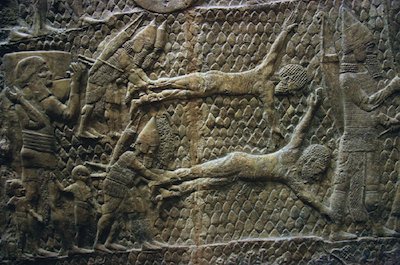
'Scene from an Assyrian wall relief portraying the horrific consequences for [those conquered by] the Assyrians' [7]
Being surrounded by all that cruelty, experiencing all that horror has got to do something to a person’s psyche. Enter PTSD. There are two types of PTSD: one happens after a single traumatic event; the other happens as a result of a cumulation of horrors. The Assyrians were making incursions into Israel as early as the 9th century BC. It is possible that many Israelites, including Jonah, suffered from PTSD.
When PTSD is triggered, a sufferer's ability to think rationally is disabled in favour of instinct-driven survival, and past threats are perceived as currently active. [8] A major characteristic of PTSD is the activation of the body's threat responses. Even in the absence of danger, the brain believes it is in peril. There are four categories of threat response:
- Fight, which activates a defence against danger
- Flight, designed to remove a person from a dangerous situation
- Freeze, which may leave a person temporarily immobilized as the brain disconnects from the body (this often happens with childhood sex abuse victims; their brains dissociate from their bodies as their only way of escape)
- Fawn, used to appease and perhaps deflect the attention of the perceived source of threat
So how does PTSD show up in the story of Jonah?
God tells the prophet to go to Nineveh, the capital city of his mortal enemies. Of course, he immediately feels threatened. Jonah's 'flight' response is engaged—and boy, does he ever run! [9]
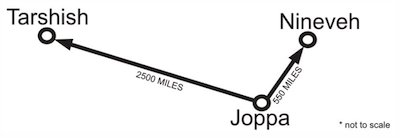
Tarshish (where Jonah heads) is almost 5x further from Joppa (Jonah’s starting point) as the distance to Nineveh
If you know the story, you'll also know that Jonah doesn't get all of the way to Tarshish, because God sends a storm to thwart his plans. Eventually, Jonah is thrown overboard and swallowed by a large fish. The Bible tells us that Jonah is in the belly of the fish for three days and three nights before he does anything else. This is a classic PTSD 'freeze' response in the midst of an inescapable situation
After this, Jonah prays. A few people interpret Jonah's prayer as repentance. However, if you read it closely, there is no confession, there's no admitting that he did anything wrong, and there's no asking for forgiveness. Jonah does, however, praise God, thank God, and submit to God. In light of these attributes of Jonah's prayer, could it be considered an example of the PTSD 'fawn' response?
When Jonah's nervous system calms down and he is no longer PTSD triggered, the fish spits him out and he's able to obey the command to proclaim God's message of destruction against Nineveh.
When God relents from punishing Nineveh following the people's repentance, something else happens in the heart of Jonah. If we've been badly victimized by an enemy, we might tend to interpret good things that happen to that person as a personal threat; we might see the good things that happen to them as equipping them with further opportunities to harm us in the future. This may be what happens with Jonah, because he appears to become re-triggered after God relents.
Jonah's 'fight' response is engaged, and he becomes angry with God. He issues ultimatums; he wrestles with the God who he'd earlier proclaimed had dominion over all creation (including himself); [10] he becomes angry over small things, like the vine dying; [11] and he begs God for death more than once. [12] This irrationality and misery are classic characteristics of a PTSD-triggered person.
Here's where the story gets really beautiful.
God ministers to Jonah.
He doesn't get angry with him.
He doesn't punish him.
But He also doesn't abandon him.
He doesn't leave Jonah alone with his trauma.
Quite the opposite.
The story of Jonah includes indications that God engineered circumstances so that several known treatments for PTSD can either be inferred or observed within the story. Here are a few:
Encountering the Sailors
Exposure therapy involves exposing a PTSD sufferer to something similar to (but not the same as) a source of trauma in order to decouple the traumatic response from non-dangerous circumstances. Like the Ninevites, the sailors were Gentiles, but they didn't pose a threat to Jonah. When the sailors and Jonah were in mortal peril from the storm, they asked Jonah to act on their behalf, just as God had earlier asked Jonah to act on behalf of the Ninevites.
Thrown into the Water
The nature of this treatment would have depended on the time of year when Jonah's experiences took place. Cold water would have activated his vagus nerve (calming down the heart rate, and soothing the nervous system). [14] Warm water would have administered hydrotherapy (in which the pressure of the warm water on each part of the body can help to bring someone in a dissociative PTSD state back into their body). [15]
Swallowed by the Fish
Being isolated can help calm a PTSD-triggered person. This would have been offset by the discomfort of the acid in the fish's belly. (The smell would not have been a factor for long; olfactory fatigue, or nose blindness, usually kicks in within a few hours. [16]) However, several other potential factors may have tipped the scales in Jonah's favour, including the rhythm of the fish's swimming (exposure to rhythmic activities can calm the nervous system [17]), and the sound of the sea currents echoing in the fish's belly (sounds of nature, especially water are also shown to be effective in relieving PTSD symptoms [18]).
There are more. But I won't go into that here. You get the idea.
In my presentation and paper, I went into the implications that the story of Jonah and his trauma has for God's mission to bring the nations into relationship with Him. But here, I'd like to focus on something a little different.
Jonah possessed neither mental health nor compassion. Upon exiting the belly of the big fish, here's what he did have:
- whitened skin, maybe with sores on it
- red eyes
- wet clothes
- possibly bleached hair
- a bad smell
I've written before that when Jonah was spit out from the fish, he must have looked and smelt like death itself. I've speculated that this may have this lent power to Jonah's proclamations of coming doom, helping the Ninevites turn from their wickedness to repentance. Perhaps God chose Jonah because He knew he would run. Jonah's running gave God the opportunity to minister to him in his trauma, and it gave God the opportunity to change Jonah into someone the Ninevites would really listen to.
I love that God can use anyone for His purposes. If we’ve been traumatized, He knows. He won’t ask more of us than we can give. But He also won’t leave us alone in our trauma or disqualify us for His work. Through the story of Jonah, God demonstrates a persistent desire to help the traumatized heal from trauma for the sake of His mission.
The story of Jonah isn't about a tug of war between Jonah and God. It's a tug of war between God and Jonah's trauma. It's about God saying, "Your trauma doesn't get the last word on whether you obey Me or not. I will not leave you alone with it. I will not let it devour you more completely than this big fish has. I will do whatever is needed—send a big storm and a big fish, send you to a big city, plant and wither a big vine—to show you how big My love and grace are to you and your enemies.
"You are not alone. I will not leave you alone. You are precious to Me. You are not your trauma. You are Mine."
It doesn't get more beautiful than that.

NOTES
[1] Olitzky, Kerry M. 2011. ‘Jonah and Self-Change’, in Yom Kippur Readings: Inspiration, Information and Contemplation, ed. by Dov Peretz Elkins (Jewish Lights) <https://www.perlego.com/book/3771807> [accessed 20 January 2026]
[2] See 2 Peter 2:15, Jude 1:11, and Revelation 2:14.
[3] See Matthew 12:38–42, Matthew 16:4, and Luke 11:29–32.
[4] See Job 1:1.
[5] Fee, Gordon D., and Douglas Stuart. 2016. ‘Jonah: Specific Advice for Reading Jonah’ in How to Read the Bible Book by Book, OliveTree edn (Zondervan). iPad
[6] Mark, Joshua A. 2018. ‘Assyrian Warfare’, World History Encyclopedia <https://www.worldhistory.org/Assyrian_Warfare/> [accessed 20 January 2026], Introduction
[7] Hays, Daniel, and Scott Duvall. 2016. The Baker Illustrated Guide to the Bible (Baker Books) <https://www.perlego.com/book/1277605> [accessed 21 January 2026]
[8] NeuroLaunch. 2024. ‘PTSD Triggers: What Happens When Activated and How to Cope’, NeuroLaunch, <https://neurolaunch.com/what-happens-when-ptsd-is-triggered/> [accessed 20 January 2026], The Process of PTSD Activation
[9] Barry, Mark. 2010. ’Jonah Location Map’ <https://visualunit.me/wp-content/uploads/2011/01/jonah_map.png>
[10] See Jonah 1:9.
[11] See Jonah 4:6–9.
[12] See John 4:3, 9.
[14] Armstrong, Amanda. 2024. Healing Through the Vagus Nerve: Improve Your Body’s Response to Anxiety, Depression, Stress, and Trauma Through Nervous System Regulation (Quarto Publishing Group). Kindle, pp. 206–210 in e-book
[15] Levine, Peter A. 2005. Healing Trauma: A Pioneering Program for Restoring the Wisdom of the Body (Sounds True). iPad, Chapter Four / First Group: Preparatory Phases / Phase 1—Safety and Containment Exercises: Finding Your Body Boundaries / Shower Exercise
[16] Seladi-Schulman, Jill. 2020.’What Is Nose Blindness and How Can It Affect You?’, Healthline <https://www.healthline.com/health/nose-blindness> [accessed 1 February 2026]
[17] Van Der Kolk, Bessel. 2014. The Body Keeps the Score: Brain, Mind, and Body in the Healing of Trauma (Penguin Books). Kobo, pp. 129, 286 of 600 in e-book
[18] Chao, Liu, Xiaotong Jing, Jing Shi, Jiaxin Li, Yuanyuan Zhang, and Weijun Gao. 2024. ‘Effects of Natural Sound on Human Stress Recovery Based on EEG Techniques’, Journal of Environmental Psychology, 97, <https://www.sciencedirect.com/science/article/abs/pii/S0272494424001385> [accessed 16 January 2026]