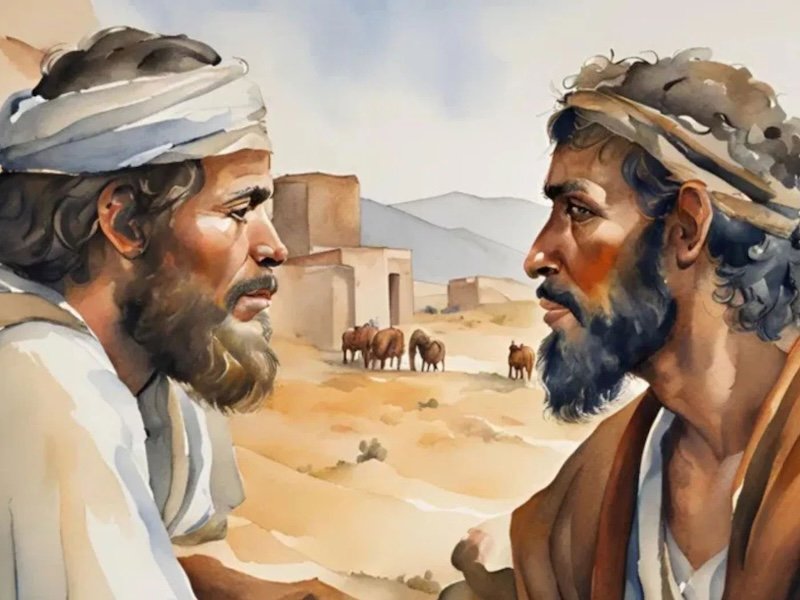
I recently came across an interesting interpretation of something that happened in Jesus' life, which I thought it might be fun to share with you today. Near the beginning of His ministry, Jesus returned to Nazareth, and on one Sabbath made a declaration of His intentions that marked a clear start to His ministry in Israel.
[Jesus] stood up [in the synagogue] to read the Scriptures. The scroll of Isaiah the prophet was handed to him. He unrolled the scroll and found the place where this was written:
“The Spirit of the Lord is upon me,
for he has anointed me to bring Good News to the poor.
He has sent me to proclaim that captives will be released,
that the blind will see,
that the oppressed will be set free,
and that the time of the Lord’s favor has come.”
He rolled up the scroll, handed it back to the attendant, and sat down. All eyes in the synagogue looked at him intently. Then he began to speak to them. “The Scripture you’ve just heard has been fulfilled this very day!”
Everyone spoke well of him and was amazed by the gracious words that came from his lips. “How can this be?” they asked. “Isn’t this Joseph’s son?”
Then he said, “You will undoubtedly quote me this proverb: ‘Physician, heal yourself’—meaning, ‘Do miracles here in your hometown like those you did in Capernaum.’ But I tell you the truth, no prophet is accepted in his own hometown.
“Certainly there were many needy widows in Israel in Elijah’s time, when the heavens were closed for three and a half years, and a severe famine devastated the land. Yet Elijah was not sent to any of them. He was sent instead to a foreigner—a widow of Zarephath in the land of Sidon. And many in Israel had leprosy in the time of the prophet Elisha, but the only one healed was Naaman, a Syrian.”
When they heard this, the people in the synagogue were furious. Jumping up, they mobbed him and forced him to the edge of the hill on which the town was built. They intended to push him over the cliff, but he passed right through the crowd and went on his way.
—Luke 4:16–30, NLT
If you’re like me, by the end of this passage, you feel like you have a case of emotional whiplash. What just happened? The crowd had just been pleased with Jesus. How could they become so enraged in the span of only three verses?
A few details about the context Jesus was living in can help to clear up our confusion. To start, let’s go back to the Old Testament and look at the full text of the Isaiah 61 passage Jesus was reading.
The Spirit of the Lord God is upon me,
Because the Lord anointed me
To bring good news to the humble;
He has sent me to bind up the brokenhearted,
To proclaim release to captives
And freedom to prisoners;
To proclaim the favorable year of the Lord
And the day of vengeance of our God
…Strangers will stand and pasture your flocks,
And foreigners will be your farmers and your vinedressers.
But …you will eat the wealth of nations,
And you will boast in their riches.
(Isaiah 61:1-2, 5-6)
This original passage talked about the day of God’s vengeance against the gentiles, when foreigners would work the land and flocks of the people of Jews, and the people of Israel would rejoice as they “eat the wealth of the nations”.
But Jesus didn’t read that part. In rabbinical tradition, a scripture reader had to read the Torah (the first five books of the Bible) without any modification. However, when reading from the prophets (including Isaiah), readers were allowed to jump short distances in the text as long as it didn’t interrupt the flow of their speech. In doing so, they could splice together a few different ideas to explain something from God’s word. In Jesus’ reading, He avoided talking about vengeance and pillaging the gentiles in favour of splicing in a verse from Isaiah 58—one that underlined His work in freeing the oppressed. [1]
This mattered a great deal. Historically, Nazareth was founded as a bulwark to counter the "invasion" of the Gentiles into Galilee—it was founded in hope of the day when Galilee would no longer be "of the Gentiles" but "of the Jews." Nazarites were fundamentalists who were eager for the restoration of their proper place in God's kingdom. [2] The Isaiah 61 passage with its judgement against the Gentiles might easily have been one of the town's favourites.
How did the people react?
Actually, according to scholar of Near Eastern scholar Joachim Jeremias, most English translations get this a little wrong.
Here’s the English version:
Everyone spoke well of him and was amazed by the gracious words that came from his lips. “How can this be?” they asked. “Isn’t this Joseph’s son?” [3]
However, the part that's translated "all were speaking well of him" generally may be a mistranslation. The original Greek word can be translated either in the positive or negative. [4] Really, it says, “All were speaking of Him.” There is no indication of good or bad—the grammar is neutral.
The (New) King James Version captures this neutrality best:
So all bore witness to Him, and marveled at the gracious words which proceeded out of His mouth. And they said, “Is this not Joseph’s son?” [5]
New Testament professor Kenneth Bailey says the most accurate translation is "all were testifying of him”. [6] (i.e., “Did you hear what Jesus said?”) Jesus’ listeners were amazed (and marvelled) at the graciousness of His words because they’d expected something far harsher to be said.
When we remove the erroneous positivity, the passage becomes much easier to follow.
Bailey asserts that the crowd didn't suddenly change its mind about Jesus. They were disgruntled from the start. This seems much more likely once we understand the the political leanings of the people of Nazareth. Let’s look at the story through this new lens:
Imagine someone from our hometown stands up in a public place and starts telling the town's favourite story. But then—wait a minute!—He ends the story early, just before He gets to everyone's favourite part. (A part, by the way, with loads of glory for us and the subjugation of our enemies.) We’d feel robbed, cheated, teased.
We all start to talk about this guy ending the story early, disgruntled at the ending.
We say, ”Isn't this Joseph's son?"
We’re not saying, ”This guy doesn't have a right to teach”—after all, we’ve just invited him to teach in our synagogue. And we know how insightful He can be after all those times He participated in our Torah study groups.
(An aside: In Jesus’ day, it was common to have Torah study groups made up of lay people. [7] This may have been where Jesus developed in the Rabbinic tradition. Jesus would surely have wowed them as He did the teachers in the temple at age 12.)
We say, "Isn't this Joseph's son?"
He grew up here, and He knows this is our favourite story, so what's He doing cutting it off so early?
"Isn't this Joseph's son? Why is He massacring what He knows is our favourite story?”
Then He goes one step further. He inverts the story. He makes the villains of the story (the gentiles) into the heroes. He implies we are less worthy than the villains. Now He hasn't just edited the Scriptures, He's outright contradicting them.
We pick up stones to kill Him for His blasphemy.
Jesus’ message of freedom from oppression, compassion, and lack of judgement towards the gentiles was the thing that got the crowd all riled up. Jesus’ comments about the widow of Zarapheth and Namaan were the final straw, but the fuse had been lit far before they were mentioned.
And that’s the point. With strands of parental favouritism running throughout their history (Isaac vs. Ishmael, Jacob vs. Esau, and Joseph vs. his brothers), the Jewish people had long projected this mentality onto God to explain why they’d been chosen above the other nations. They’d created social fortifications against anyone deemed an outsider to God’s “favour”—including people who were sick and disabled, women, or poor.
But Luke’s gospel, more than any of the others, is inclusive. More than two dozen story pairings teach spiritual principles from the perspective of both men and women, the faith of some gentiles is portrayed as exceeding that of any Israelite, and disabled and diseased people are welcomed into Jesus’ presence openheartedly.
This is Jesus’ cry to the outcast and oppressed, and to us:
“You there! Everyone who thirsts, come to the waters;
And you who have no money come, buy and eat.
Come, buy wine and milk
Without money and without cost.
Why do you spend money for what is not bread,
And your wages for what does not satisfy?
Listen carefully to Me, and eat what is good,
And delight yourself in abundance.
I am the bread of life; the one who comes to Me will not be hungry,
and the one who believes in Me will never be thirsty.
All that the Father gives Me will come to Me,
and the one who comes to Me I will certainly not cast out.”
—Isaiah 55:1-2, John 6:35, 37
Come, eat, and be satisfied. The table is open for all; and all are welcome.
NOTES
Unless otherwise indicated, all scriptures are taken from the NASB.
[1] Bailey, Kenneth. 2009. Jesus Through Middle Eastern Eyes: Cultural Studies in the Gospels (IVP Academic) <https://www.perlego.com/book/1034085](https://www.perlego.com/book/1034085> [accessed 2 September 2026]. Kobo: Chapter 12. Commentary
[2] Bailey 2009: Commentary
[3] Luke 4:22.
[4] Bailey 2009: Chapter 12. Commentary
[5] Luke 4:22, NKJV.
[6] Bailey 2009: Chapter 12. Commentary
In the Japanese version of the Bible (聖書新改訳2017), a few alternates are offered: 確認, or “confirmed” (i.e., Did he really say that?” “Yes, he did!”); and 話言, or “testified”.
[7] Bailey 2009: Chapter 12. The Inauguration of Jesus’ Ministry
 We’ve been taking a brief look at how East Asians understand salvation, and how this changes our ideas of what it means to share the good news of Jesus within the context of East Asia. Today, let’s continue the conversation along a few additional dimensions.