Living in Japan, being surrounded by a culture whose primary mode of communication is indirect—it changes you.
As a Canadian, I’m no stranger to indirect communication, but the Japanese take it to a whole other level. In our experience, words only communicate about half what is meant. In any given conversation, it’s up to the listener to understand what the speaker is saying, through observing non-verbal cues, such as facial expression, body language, and even a few mouth sounds. As you can imagine, such indirect communication can get a little tricky at times. This is true even from the perspective of people born and raised in Japan. We have a few Japanese friends who freely admit that they also can’t figure out what’s actually being said in some conversations! (That’s why texting and emojis became popular in Japan before Canada: they allow the Japanese to express themselves more directly, while still being socially appropriate. We learnt early that if you absolutely need a clear answer, you should text!)
Two thirds of the world (i.e., the ‘Majority World’) communicates dominantly using indirect communication. These methods are present in Africa, Latin America, and the Middle East. They were present in ancient Israel, both in the time of Jesus, and in the time of the patriarchs; so, they can be quite fascinating to observe in the Bible stories. Today, I thought I’d go through one such story with you, and point out a few things happening below the surface.
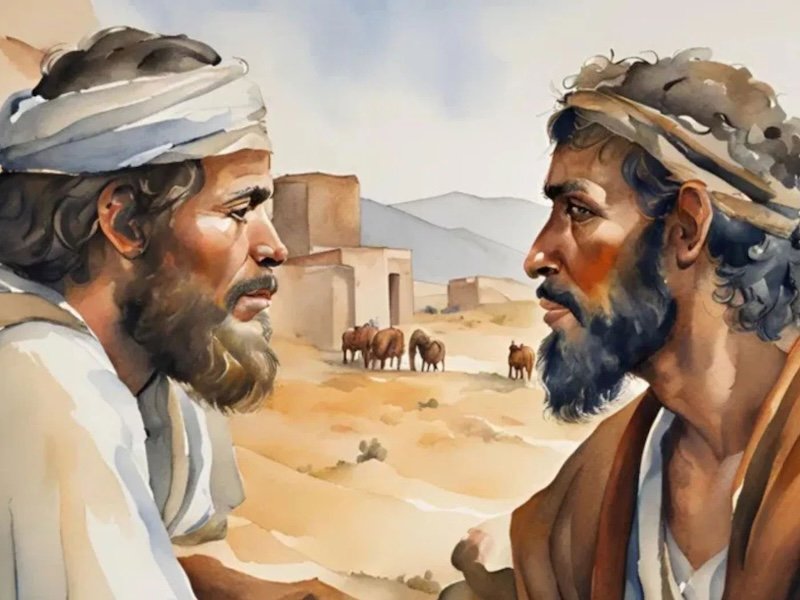
Let’s first set the stage. Jacob is on his way home. He’s spent decades living with his father-in-law, Laban. He’s married two women, and has a slew of children, sheep, and various other belongings. He’s a rich man, but he’s scared for his life. Before fleeing to Laban, he had grievously wronged his older brother, Esau. He’d stolen their father’s blessing, usually reserved for the firstborn son; and he’d manipulated his way into receiving the lion’s share of the inheritance Jacob and Esau were to receive. Now, he’s returning home, but he fully expects Esau to murder him. So, he divides up his family. If Esau wants to murder Jacob, he’ll have to kill Jacob's wives and children, first. Maybe at some point he’ll get tired of all the killing, before he gets to Jacob. There’s bravery for you.
Out goes his first wife and her children.
Next, his favourite wife and her children.
Last, Jacob.
But Esau ran to meet Jacob and embraced him; he threw his arms around his neck and kissed him. And they wept. Then Esau looked up and saw the women and children. “Who are these with you?” he asked.
Jacob answered, “They are the children God has graciously given your servant.”
Esau asked, “What’s the meaning of all these flocks and herds I met?”
“To find favor in your eyes, my lord,” he said.
But Esau said, “I already have plenty, my brother. Keep what you have for yourself.”
“No, please!” said Jacob. “If I have found favor in your eyes, accept this gift from me. For to see your face is like seeing the face of God, now that you have received me favorably. Please accept the present that was brought to you, for God has been gracious to me and I have all I need.” And because Jacob insisted, Esau accepted it.
Then Esau said, “Let us be on our way; I’ll accompany you.”
But Jacob said to him, “My lord knows that the children are tender and that I must care for the ewes and cows that are nursing their young. If they are driven hard just one day, all the animals will die. So let my lord go on ahead of his servant, while I move along slowly at the pace of the flocks and herds before me and the pace of the children, until I come to my lord in Seir.”
Esau said, “Then let me leave some of my men with you.”
“But why do that?” Jacob asked. “Just let me find favor in the eyes of my lord.”
So that day Esau started on his way back to Seir. Jacob, however, went to Sukkoth, where he built a place for himself and made shelters for his livestock. That is why the place is called Sukkoth.
After Jacob came from Paddan Aram, he arrived safely at the city of Shechem in Canaan and camped within sight of the city.
—Genesis 33:4–5, 8–18
To start, Esau’s question—"What do all these gifts mean?”—and Jacob's answer, "To find favour with you" appear to be directly given.
However, Esau’s refusal ("I have plenty") may be for the sake of politeness. This would be similar to the time when Abraham bought the place he would bury Sarah, from Ephron the Hittite. [1] At that time, when Abraham asked to buy the land, at first Ephron refused to accept any money. Perhaps accepting too quickly would have been a sign of financial need and weakness. Perhaps it would have been an uncouth prioritization of money over relationship. However, when Abraham insisted on paying for the land, Ephron accepted; likewise, when Jacob insists, Esau takes the gifts.
Next, Esau offers to travel with Jacob. Jacob flat out refuses. But to save face for Esau, Jacob blames the needs of the women and children and flocks. His reasoning is unlikely to have had anything to do with caring for them—after all, minutes before he had been willing for all of them to die so that he might live!—but it's an excuse that would be plausible enough for Esau.
Through the use of exaggeration, Jacob implicitly communicates that he will not budge on this point:
"If they are driven hard one day, all the flocks will die."
There may be a couple of reasons Jacob uses this exaggeration:
- To show non-negotiability, or
- To communicate that Jacob is weak and no threat to Esau.
In response, Esau offers to leave some of his people with Jacob's company. After all, if Jacob is really so weak, he will need protection from potential marauders, right?
When Jacob refuses, his meaning becomes clear to Esau. The mention of his flocks and family was only an excuse, not a real problem. Jacob simply doesn’t want to travel with Esau. He’d said he would travel "at the pace of the children" until he came to Mount Seir (Esau’s home). Now, however, it’s obvious that he will be unlikely to ever come to Mount Seir. In the future, if necessary, the children will develop "needs" that prevent him from coming.
The two brothers part ways, amicably, though perhaps not fully reconciled.
Following this, Jacob settles first at Succoth, and then moves to Shecham—which is exactly opposite to the direction of Mount Seir. Now even we Westerners get the message: Jacob will not be going to Mount Seir after all.
Can you think of other times when indirect communication shows up in the Bible stories? Feel free to let us know what you see!
NOTES
Unless otherwise noted, all scriptures are taken from the NIV.
[1] See Genesis 23:7–16, especially verse 11.

 We’ve been taking a brief look at how East Asians understand salvation, and how this changes our ideas of what it means to share the good news of Jesus within the context of East Asia. Today, let’s continue the conversation along a few additional dimensions.