Over the course of researching a paper for one of my seminary classes, I stumbled across The Tears of Lady Meng, an old Chinese folktale which a Taiwanese Christian thinker named C.S. Song repurposed to convey some important spiritual truths. Song wrote his reinterpretation of this fable as a spiritual commentary of 1981 China, but as you will see, it now has massive applications to the West of today.
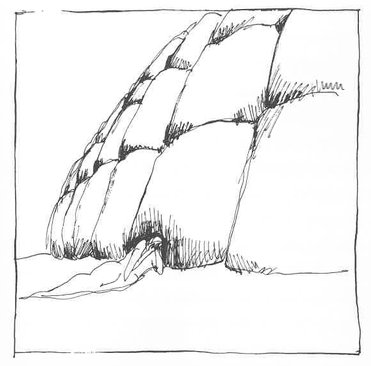
In the folktale, the Chinese Emperor is in the midst of building the Great Wall of China to protect his country from invasion. Advised that his wall will become stronger if he encases a man at each mile along its ten thousand mile span, the Emperor prepares for a massive human sacrifice. At the last moment, someone suggests that by burying someone with the name "Wan" (meaning "ten thousand") in the wall, only one life will be forfeited. On the Emperor's orders, a man named Wan is dragged from his wedding feast, where he has just been married to Lady Meng, and encased in the wall.
Following this, Lady Meng goes on a quest to find the bones of her murdered love, but when she reaches the wall, she realizes the futility of her task and collapses, weeping. Her tears are so plentiful that a section of the wall in turn collapses and reveals her husband's remains. The Emperor, hearing of Lady Meng's quest, wants to meet her. When she is brought to him, he is dazzled by her beauty and wants to marry her himself. She agrees, on condition that:
- a 7-week feast is held to honour her late husband
- a huge altar is built where she can offer a sacrifice to her husband at the end of the feast
- the emperor and all the highest officials of the land will attend the offering
When the time comes for the offering, Lady Meng climbs to the top of the altar’s scaffolding and publicly decries the Emperor's evil and cruelty before she throws herself off the altar and into the river below. Flying into a rage, the Emperor orders his soldiers to retrieve and desecrate her remains by chopping them up and throwing them back into the river. When they do so, the pieces of Lady Meng's body turn into little silver fish that will live forever.
After retelling this folktale, C.S, Song goes on to draw out "a political ethic of the cross of Jesus". [1] From here on, I'm going to share a brilliant section from a 1994 doctoral dissertation which summarizes Song’s findings.
The folktale is firstly one of idolatry; the Emperor worships a God called "National Security.” In the name of this savage and insatiable god, human lives are sacrificed in countless numbers. In the absolute dedication of the Emperor to the national defence of his land, human beings are made expendable. People become disposable as "so much grass and weeds.” According to Song, this is the dynamic of many repressive regimes in Asia today where "martial law court trials and ritual murders are committed on the altar of national security, the supreme god."
In reality, the idolatry of national security is the idolatry of power. The tale therefore uncovers this idolatry of power for what it is, that is, a cult securing the rulers while the people suffer. The cult of national security secures those in power: ruling parties, autocratic rulers, and dictators at the expense of the nation and ordinary people. What kind of "political theology" and "power ethic" can hope to confront such Titanism? This is an important question for Song.
Apparently, he is not alone in this concern. Many other Asian people are asking the same question, particularly in view of their real experiences in the political events of modern times. Experiences such as the tragedy of the Kwangju uprising in Korea in May 1980, the suppression of the Human Rights Day Rally in Taiwan in 1979, the suspension of the right of prisoners to challenge their detention under martial law rule in the Philippines, military presence at every level of government and big business in Indonesia, the massacre of students and civilians in the pro-democracy movement in Tiananmen Square on June 4, 1989, and the like. Not only Christian but Buddhists, Hindus, Muslims, believers and non-believers alike are seeking for an answer.
What Song is suggesting is a theology of the people or "folk political theology.” That is, a political theology experientially rooted in the people's tears and suffering and theologically founded on participation in God's history of suffering people. A political theology of this kind will unmask the idolatry of power that is so prevalent in the world today and especially in Asia. Such a theology is deemed appropriate because this in fact is precisely the political theology of Jesus Christ himself. It is "the theology of living with people." But how can a "power ethic of living in Christ with people" overcome the dictators' power?
Song asserts that like Jesus, God is moved to tears in the tears of the people. The Christian political response can thus no longer be towards a theocracy nor violent revolution. The well-springs of transformation are in the people's tears of humiliation, oppression and misery; its dynamic comes from the priority of love over might as we dare to speak the truth to the oppressor. This is exactly what the folktale depicts. The immovable mighty Wall gives way to the tears of Lady Meng thus unearthing the bones of her husband. Tears having their source in love have the power to bring down the powerful Wall. Tears welling out of Lady Meng's heart of love leads her to confront the cruel Emperor with the truth. And it is this encounter with the truth which unearths political lies and brings about the transformation of power.
In subtle contrast to Latin American theologians of liberation, Song contrasts the mighty, powerful God of the Exodus, the God who vanquishes the Egyptian army, with the incarnating, vulnerable God of Jesus Christ. Love is moral power in weakness and the power ethic of love disarms the "power that rapes." Love has the power to defeat the power that oppresses, impoverishes, humiliates and dehumanizes people. Thus Song can speak of the "survival of the unfittest."
This all sounds very noble, but can this "tearful truth" be politically effectual? Song is emphatic that Christ-like powerlessness can transform into a different mode of powerfulness. We are to encounter the powerful in the powerlessness of Christ, staking our lives on the claim that the powerful of the world cannot stand against the truth, and thus filling their ears with the tears and pain of the people's history. In this way it is possible to participate in the "history of the cross and resurrection in Asia." [2]
There is not much more to add to this. Truth without love is cruelty. Love without truth is flimsy. But love joined with truth, as it was in Jesus, is eternal.
This parable showcases an important principle: the strong are not those most equipped to resist evil. The weak are. When we embrace our own vulnerability and courageously showcase it, our persona no longer stands in the way of our message. When ego is removed, our message shines even more brightly. It cannot be silenced if we have already let go of everything that evil people can threaten. This is when "the foolishness of God is wiser than men, and the weakness of God is stronger than men." [3]
Just as God said it to Paul, He also says it to us: "My grace is sufficient for you, for power is perfected in weakness." [4]
And along with Paul, we can respond:
"Most gladly, therefore, I will rather boast about my weaknesses, so that the power of Christ may dwell in me. Therefore I am well content with weaknesses, with insults, with distresses, with persecutions, with difficulties, for Christ’s sake; for when I am weak, then I am strong."
—2 Corinthians 12:9–10
RELATED POSTS
What is Christian Nationalism?
NOTES
Unless otherwise noted, all Scriptures are taken from the NASB version.
[1] C.S. Song. 1981. The Tears of Lady Meng: A Parable of People’s Political Theology (WCC): p. 25
[2] Koria, Paulo Tema. 1994. ‘Indigenous Theology - Two Attempts? A Study in the Writings of Dr. Kosuke Koyama and Dr. Choan-Seng Song’ (unpublished doctoral thesis, University of Otago): pp. 616-619
[3] 1 Corinthians 1:25.
[4] 2 Corinthians 12:9.