Over the past few weeks, we’ve gone on a journey looking at the nature of Christian Nationalism; and examining an old Chinese folktale underlining the power of the weak in combating unjust political structures. Today I’d like to finish by looking at how the structures of Christian Nationalism have impacted the spiritual climate of my own field of ministry in Japan.
As we’ve seen already, Christian Nationalism is not a new thing. American missionary Vincent Donovan wrote about it back in 1982, and even pointed out that it was used as a tool in WWII-era Germany. [1] I would suggest that Japan also encountered Christian Nationalism in a significant and spiritually-shattering way at the end of that war. These reverberations continue in the spiritual landscape of Japan today.
First, let’s refresh our memories on the nature of Christian Nationalism, which aims to “take back” one’s nation for God. It is essentially an idolatrous tribal religion that discards the core principles of Christianity, and elevates country above God, in the name of God. It believes that its nation is chosen and specially favoured by the tribal god. In praying for the god’s favour in winning wars or sporting matches, believers assert the tribal god is willing to subjugate the peoples of other tribes/countries to the dominance of their own. He cares less what is done to other people, as long as the favoured nation is taken care of.
Vincent Donovan observed that although most tribal religions are monotheistic, the very existence of tribal religions leads to polytheism. In other words, although each tribe may worship only one god, many gods must exist—one to service each tribe.
What does this mean for mission in Japan?
Quite a lot, actually.
You see, I think the Japanese probably understand the tribal nature of Christian Nationalism better than Westerners do.
Japan is a nation with many gods. It has more than 8000, many of them associated with nature, in addition to the ancestors that are also worshipped. In Japanese history, as Buddhism entered the country and began to take hold, the Shinto god (Tado) surrendered to Buddha. This was followed by a national turning towards Buddhism as a dominant religion within Japan. [2]
Up until the end of World War II, the Japanese Emperor had been considered a god. However, after losing the war, he was forced by the Americans to renounce his deity. His “confession” explicitly stated that he was in fact human and not a god. [3] In the words of Kosuke Koyama, a Japanese Christian theologian, ”The [Shinto] Tado god was impressed by the Buddhist god. The emperor was impressed by the American God." [4] In this statement, Koyama is implicitly declaring the tribal nature of the American God. Koyama would later go on to say, "In 1945 the Japanese people began to feel that the American God is stronger than their own god." [5]
If we are attempting to understand the spiritual dynamic of Japan now, we must recognize that that the Japanese did not halt their worship of the nature-gods of Shinto when they embraced the Buddhist gods. Wanting to hedge their bets, the Japanese developed the practice of merging or amalgamating their existing gods with new ones to ensure that they were fully covered. [6] We can see this even today in the statistics on Japanese religious practice: [7]
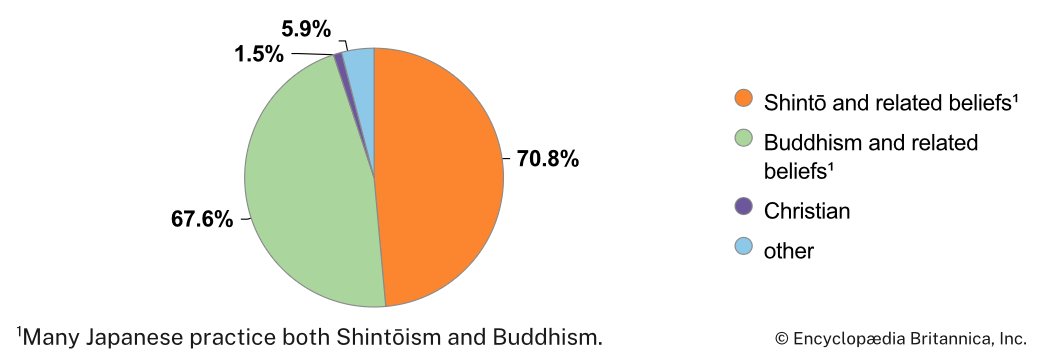
There is a significant population in Japan (~30%) that is entirely secular (practicing no religion), so almost 100% of non-secular Japanese people practice at least two religions.
The totals always add up to more than 100%. It’s no wonder, then, that the foreign tribal god of Christianity was simply added to the Japanese pantheon as a God who should not be ignored.
It’s worth mentioning that prior to WWII, most Japanese students of Christian theology studied in Germany. However, afterwards, with Germany defeated, budding Japanese theologians turned to the United States. As Singaporean missionary to Japan How Chuang Chua once put it, "[T]he decision to study in the land of the victors was an easy one to make.” [8]
With the Japanese understanding of the American God as one (albeit a very powerful one) among many, the Japanese have fully integrated Him into their pantheon. It is said that when someone is born, they have a Shinto ceremony; when they are married, they have a Christian wedding (complete with a white wedding dress and all the pageantry); and when they die they have a Buddhist funeral.
This level of religious integration presents an near-insurmountable challenge to Christians who believe that Jesus is the only way to God. New Christians who attempt to follow this principle may be seen as abandoning their families when they don’t join in worshipping their ancestors, and are encouraged by their families not to abandon Jesus, but to slot Him into His “proper” place, amongst the rest of the pantheon. In time, most end up capitulating and following this practice.
When Western missionaries take the “easy” route the Japanese offer—of bypassing the usual decades-long practice of apprenticeship in favour of presenting themselves as experts in Christianity, simply by virtue of their culture—they only reinforce the “Western” nature of the American God. This is a God who has exerted dominance over Japan, but is not truly for Japan.
This differentiation is not trivial. (Why would they be interested in worshipping a God whose primary interest is in dominating and subjugating them?) Nor is the sheer number of Christian missionaries who adopt this implicitly colonial mindset trivial. In our experience, 80-90% of missionaries to Japan either actively claim to be experts in Christianity by virtue of their culture, or they do not challenge this principle when the Japanese showcase it on their behalf.
The damage Christian Nationalism has done to the spiritual wellbeing of the Japanese is incalculable. As missionaries, we will be held accountable for our actions and attitudes in this. It is only by embracing weakness and humility that these toxic behaviours can be counteracted.
A few questions for missionaries to Japan to ponder:
・When presented with the mantle of authority, do we take it up?
・Are we willing to spend decades in apprenticeship, rather than stepping into the pulpit right away?
・How often are we taught by the Japanese, rather than teaching them?
・How much time do we spend comparing biblical and Japanese cultures, and appreciating the ways that Japanese people can understand many biblical principles better than we can?
・How much time do we spend affirming Japanese Christians, assuring them that their understanding of Christ is just as valid as—or more valid than—our own?
・Do we allow ourselves to be called “sensei” outside of an English-teaching environment? (Matthew 23:8; try reading this in your 聖書新改訳2017, too)
RELATED POSTS
What is Christian Nationalism?
NOTES
[1] Vincent Donovan. 1982. Christianity Rediscovered: An Epistle from the Masai (SCM Press): pp. 45-46.
[2] Kosuke Koyama. 1984. Mount Fuji and Mount Sinai: A Pilgrimage in Theology (SCM Press): pp. 179-180.
[3] Ibid: 183.
[4] Ibid.
[5] Ibid: 184.
[6] Ibid: 178.
[7] Britannica. 2026. ‘Japanese Religion’, Britannica <https://www.britannica.com/topic/Japanese-religion> [accessed 10 May 2026]: Japan Religious Affiliation.
[8] How Chuang Chua. 2021. Japanese Perspectives on the Death of Christ (Regnum Books). Kobo: Chapter 6: Koyama Kōsuke and the Crucified Mind / Koyama's Theological Pilgrimage / Theological Studies in Tokyo (1946-1952).