Having experienced spiritual abuse, emotional abuse, physical abuse, financial abuse, and more, today I would like to share with you one of the most important lessons I've learnt.
Your abusers will tell you the opposite, but...
Resistance against evil is not rebellion.
Evil will tell you that resistance and obedience are opposites. That in order to be obedient, you cannot resist.
Evil will tell you that unless you are 100% obedient to every demand, you are rebellious.
Evil will tell you that the abuse you're experiencing is your fault.
Evil will tell you that you've brought its horrors on yourself.
Evil will enumerate the reasons for the abuse you're experiencing. Evil will try to make the abuse you're experiencing your fault. Your reality may become so twisted (for a while) that you even believe their blame-shifting.
But here's the truth:
"Evil doesn't need a reason." [1]
Evil would exist even without the "reason" it has assigned to abusing you.
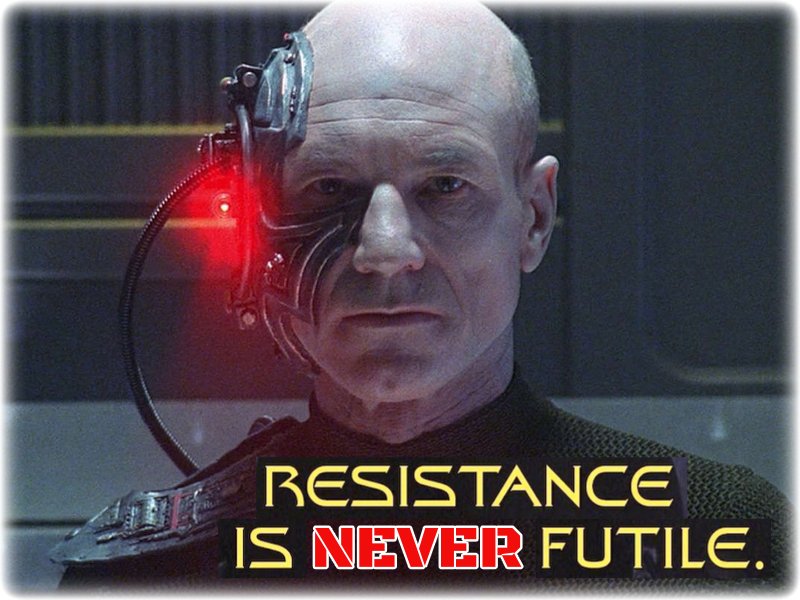
So why is resistance never futile?
Because anything LESS will cause you grave harm.
What do I mean by "anything LESS"?
- Capitulation is LESS
If we capitulate to evil, we remove our own sense of agency, of choice. We give the responsibility for our wellbeing over to someone who has no interest in it. We tell ourselves we're helpless—and this becomes a self-fulfilling prophecy.
A pair of university professors once did a study in which they repeatedly shocked dogs trapped in locked cages. After the dogs had become used to the shocks, the cage doors were opened, and shocks re-administered. A control group of dogs, who had not experienced the initial shocks, immediately escaped. The group that had been conditioned to "inescapable shock" remained in their cages, whimpering. They had learned helplessness, and the lesson could not be easily undone. In fact, these professors found that the only way to teach the traumatized dogs to go through their open doors was to repeatedly drag them from their cages so they could experience what it was to escape. [2]
If we capitulate to evil, we become people who prefer to be abused rather than venturing out into a scary world that's different from the abusive one we've known.
- Rebellion is LESS
Just as capitulation causes a grave psychological injury, rebellion causes a grave spiritual injury. Resistance and rebellion are opposites:
Where rebellion is founded on pride, resistance is founded on humility.
Rebellion trusts in its own accomplishments and is self-sufficient. Resistance embraces submission to God and trusts in Him alone.
Rebellion makes itself the hero of its story. Resistance shrinks from being the hero and embraces the motto "He must increase but I must decrease." [3]
Rebellion exhibits the deeds of the flesh (enmities, strife, jealousy, outbursts of anger, disputes, dissensions, factions [4]). Resistance exhibits the fruit of the Spirit (love, joy, peace, patience, kindness, goodness, faithfulness, gentleness, and self-control [5]).
Rebellion rages, is violent, hates. Resistance loves, coaxes, persuades.
Rebellion and resistance both challenge evil, but they do so differently. Rebellion wages war. Resistance wages peace.
Resistance isn't afraid to use strong language, but it also submits to human authority as much as possible. Jesus submitted to the Romans who killed Him. He was not afraid to call out the Pharisees for their spiritual abuse and hypocrisy, but He also demonstrated a level of submission to the Pharisees:
"The teachers of the law and the Pharisees sit in Moses’ seat. So you must be careful to do everything they tell you. But do not do what they do, for they do not practice what they preach."
—Jesus [6]
Rebellion opposes everything about the abuser. Resistance opposes only the abuse.
Rebellion looks like Barabbas. Resistance looks like Jesus.
It's important that we guard our hearts against sins of rebellion and bitterness; or else the evil that is "out there", abusing us, will become evil "in here", planted in our very own hearts. Forgiveness each step of the way is a key ingredient to remaining spiritually sweet rather than becoming sour.
Abusers thrive by fraudulently claiming ownership over things that God owns: authority, power, and righteousness.
"The first characteristic of an abusive religious system is what we call power-posturing. Power-posturing simply means that leaders spend a lot of time focused on their own authority and reminding others of it, as well. This is necessary because their spiritual authority isn’t real—based on genuine godly character—it is postured." [7]
Abusers are very fond of quoting a verse in Romans to reinforce their power over their prey:
"Every person is to be in subjection to the governing authorities.” [8]
They don't want you to remember that the verse right before this one says:
"Do not be overcome by evil, but overcome evil with good."[9]
Not being overcome by evil must be first in our hearts, before we submit to authority.
It is possible to submit to authority and not be overcome by evil, even when surrounded by abuse. Each abuser in my life has been someone with a level of authority. In each case, I did my best to submit to their non-abusive demands, but I also engaged in some sort of resistance against their abusive demands. Let me show you what I mean.
When a parent is dragging you somewhere by the hair and you pull back? It's as if you're pulling your own hair. It hurts. And yet, I often did this. I wasn't a masochist. It made no difference to the result of my external, physical world. But it made all the difference to my internal, emotional one. This inner resistance to abuse has shaped my interactions with every abuser who has entered my life: I never gave in to the abuse I recognized or became the dog on the mat. When my parents asked me to do the various things that parents normally ask their kids to do, for the most part, I obeyed. (I'm not saying I was perfect—every kid disobeys sometimes—but I was a pretty good kid. Except to babysitters. I was awful to babysitters. I still feel bad about that.) |  |
When my financially dominant parent cut off every avenue of earning or receiving money from my teenage self, on occasion demanding I literally kiss his feet in exchange for spending money, I didn't steal. Yes, this weakened my ability to care for myself. There were times I had to beg for basic necessities, and even then wasn't always successful at getting them. By the time I was denied potable water on a family vacation in my late teens, I was done begging. After stating my need a few times, I waited. Yes, I got very thirsty and this cost me physically, but I avoided the much deeper spiritual wound of becoming a thief. |  |
When leaders in our former organization tried to force a medical decision foreseeably resulting in lifelong injury, and abused Peter and me when I exerted my right to choose my own treatment, I was respectful in my refusal. In all other requests, we cheerfully submitted, being careful to make sure there was only this one point of difference between complete obedience and our actions. They would eventually fire us; over the next nine years, we poured every penny we had, including two entire inheritances, into recovering from their abuse. Meanwhile, God paved the way for a new ministry—something completely different and breath-taking. |  |
After fleeing someone who'd abused me for decades, I still published my book about how to find freedom through forgiving. In the face of a smear campaign by that abuser, I let my silence declare my innocence. My silence wasn't a capitulation to abuse, but a refusal to allow abuse to change who I was or to muzzle my message. Just before publishing, I remember wondering if I should go ahead with my planned advertising campaign or just quietly release my book and let things die down. I knew I had an important message. I knew I'd followed every single principle in my book with each of my abusers. In the end, I went full steam ahead. The people who were spreading my abuser's lies would label me a hypocrite no matter what I did. If I became an audacious enough "hypocrite", would they begin to question their own gossip? |  |
When a pastor attacked the forgiveness I'd offered that abuser, stating that the only godly path forward was "loving my abuser into repentance", and demanding I do an emotional strip tease in front of his (male) church board to "prove" my decision to flee was justified, even though I'd privately explained it to him, I submitted to his stated alternative and didn't force the issue. Since I wasn't allowed to speak at his church, I chose to treat myself with dignity and refrained from visiting his church service so I wouldn't have to field questions about why I wasn't speaking. That pastor seemed to take my "disobedience" as a personal affront, and his church would eventually halt its partnership with our ministry. [10] |  |
Yes, there are costs to resisting while submitting. Yes, it might cause you pain. But these costs are worth paying because when we obey God, we remain spiritually intact.
We can submit to our abusers' authority but not their abuse.
Let me be very clear—submitting to an abuser's authority does not mean that we allow ourselves to continue to be abused. It does not mean that we don't protest or that we bury our heads in the sand.
God has given us stewardship over our selves. We are to be responsible caretakers over the precious people He has created us to be. Submitting to an abuser's authority does not mean we do not take steps to be released from the abuse. We can—and should—set boundaries. If boundaries are continuously violated, we should feel free to explore legal protections, and take steps to remove ourselves from the abuser's reach. This may mean we limit our interactions with them. Or, in extreme cases, it may mean fleeing and going zero contact.
On the subject of rebellion, let me be very clear. Your abusers will expect you to follow their demands 100% of the time, or else they will label you as rebellious.
But the truth is that no human being deserves to be obeyed in every possible situation, regardless of what they request.
Only God deserves to be obeyed like that.
Our abusers, when they demand we comply with their requests—no matter what—are demanding that they become our idols.
They covet God's position and actively try to usurp it.
So we are faced with a decision.
Will we lay ourselves down on the altars of their abuse, in an act of worship?
Or will we choose not to throw our pearls before swine [11] and be torn to pieces?
You and I each need to make a choice.
Will we choose to submit to those in authority as long as we're not participating in evil either by commission or omission; and choose to resist evil to the fullest extent, without allowing malice to grow in our hearts?
Will we choose to follow our Saviour, who proclaimed good news to the poor, announced freedom for the prisoners, and came to set the oppressed free? [12] Will we choose to love our neighbours [13] and act for their wellbeing?
I choose to love my enemies and forgive them.
I choose to worship Jesus alone.
What about you?

NOTES
All scripture references taken from the NASB unless otherwise noted.
[1] Newsletter communication (email) from Crossworld, May 28, 2025.
[2] Van der Kolk, Bessel. 2014. The Body Keeps the Score: Brain, Mind, and Body in the Healing of Trauma (Penguin Books). Kobo, pp. 107-111 of 1217 in e-book.
[3] John 3:30.
[4] See Galatians 5:20.
[5] Galatians 5:22–23.
[6] Matthew 23:2–3, NIV.
[7] Johnson, David and Jeff Van Vonderen. 1991. The Subtle Power of Spiritual Abuse: Recognizing and Escaping Spiritual Manipulation and False Spiritual Authority within the Church (Bethany House Publishers). Kobo, p. 146 of 611 in e-book.
[8] Romans 13:1.
[9] Romans 12:21. Remember, chapter and verse numbers were not present in the original text of the Bible. They were added later, for navigation purposes. In the original text, Romans 12:21 flowed directly into 13:1.
[10] I would later write letters to the entire church board demonstrating the reckless endangerment implicit in a "fleeing is sinful" attitude, and making recommendations on things they could do to avoid endangering the next abused woman fleeing for her life.
[11] See Matthew 7:6.
[12] See Luke 4:18–19.
[13] See Luke 10:27.
Visual sources: Main picture ; all other pictures were free stock photos, obtained from Pexels.