"The eye is the lamp of the body. If your eyes are healthy, your whole body will be full of light. But if your eyes are unhealthy, your whole body will be full of darkness. If then the light within you is darkness, how great is that darkness!"
—Jesus (Matthew 6:22–23, NIV)
In my 40+ years as a Christian, I’ve only ever heard one sermon on this passage. In it, the pastor acknowledged the scientific inaccuracy of Jesus' statements, talked about how these verses prove how fully Jesus immersed Himself in a human context—even to the point of embracing and teaching on mistaken scientific interpretations—and then moved on to heroic attempts to "rescue" the passage from inaccuracy and usher it into some sort of relevance to our lives today.
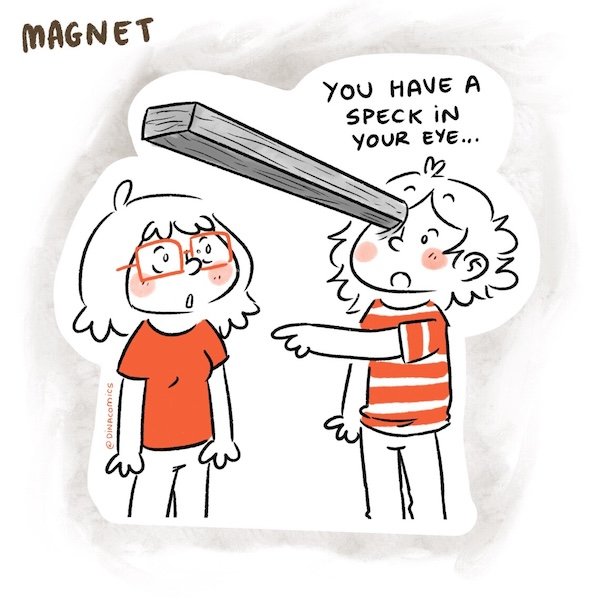
But what if Jesus' words were never meant to be scientifically accurate? What if they were always intended to be metaphorical? [1] If this is the case, examining Jesus' words through a scientific lens would be just as ludicrous as expecting:
- people who are negatively affected by something to have the skin peeled from their faces ("It's no skin off my nose")
- trailblazers to be followed by a percussion section ("She marches to his own drummer")
- students to have bruised knuckles ("I'm going to hit the books")
- emotionally expressive people to be covered in blood ("He wears his heart on his sleeve")
You get the idea.
"So what's the metaphor?" you might ask.
I'm glad you did.
What if in this passage, Jesus is talking about perception?
When we develop conspiracy theories, when we become cynical, our world darkens. Our spirits darken. We struggle more. We stumble more.
We can see this is true with very little effort. If I've been recently traumatized, I’ll be inclined to perceive additional traumatizers lurking around every corner. If I've got a conspiracy theory mindset, I’ll easily find more conspiracy theories. (The Bible has something to say about conspiracy theories, by the way. Take a look at Isaiah 8:12.) If I embrace self-righteous and judgmental attitudes, I’ll always be able to find new targets for my harshness.
When we only see the bad in people, when we stop giving the benefit of the doubt, when we always assume the worst—our spirits and bodies fill with darkness. Make no mistake: spiritual and emotional darkness have very real repercussions for our bodies. They can result in increased stress, depression, cardiovascular disease, and more. [2]
We may not always be able to govern what our eyes see—although (despite our excuses) we usually can govern more than we think we can!—but we can govern our methods of processing. We have control over where our thoughts go.
Instead of allowing our minds to endlessly loop on things that darken our souls, we have the ability to take our thoughts captive. We have the ability to say, “No, I will not engage this thought,” and then fix our eyes on Jesus, the author and perfecter of our faith. We have the ability to reorient ourselves to think about “whatever is true, whatever is noble, whatever is right, whatever is pure, whatever is lovely, whatever is admirable” (Phil. 4:8).
So, I suppose the question is: will we allow our world to become filled with darkness?
Or, will we open our hearts and allow the light to shine in?
“If therefore your whole body is full of light, with no dark part in it, it will be wholly illumined, as when the lamp illumines you with its rays.”
—Jesus (Luke 11:36, NASB 1995)
NOTES
[1] The idea of a metaphorical interpretation is even supported by Jesus' words themselves. In that last sentence, He talks about light becoming darkness, which reminds me of the metaphors in John 1. This language only makes sense through the lens of metaphor, and practically begs us to examine the entire passage from this viewpoint. Incidentally, this word for eyes was used metaphorically in other areas of scripture to denote perception (i.e., Luke 24:31, Acts 26:18, Ephesians 1:18).
[2] Visser, Richard, and Susan Ayers. 2025. Psychology for Medicine and Healthcare, 4th edn (SAGE Publications Ltd) <https://www.perlego.com/book/5212559> [accessed 6 September 2026]: 70.